
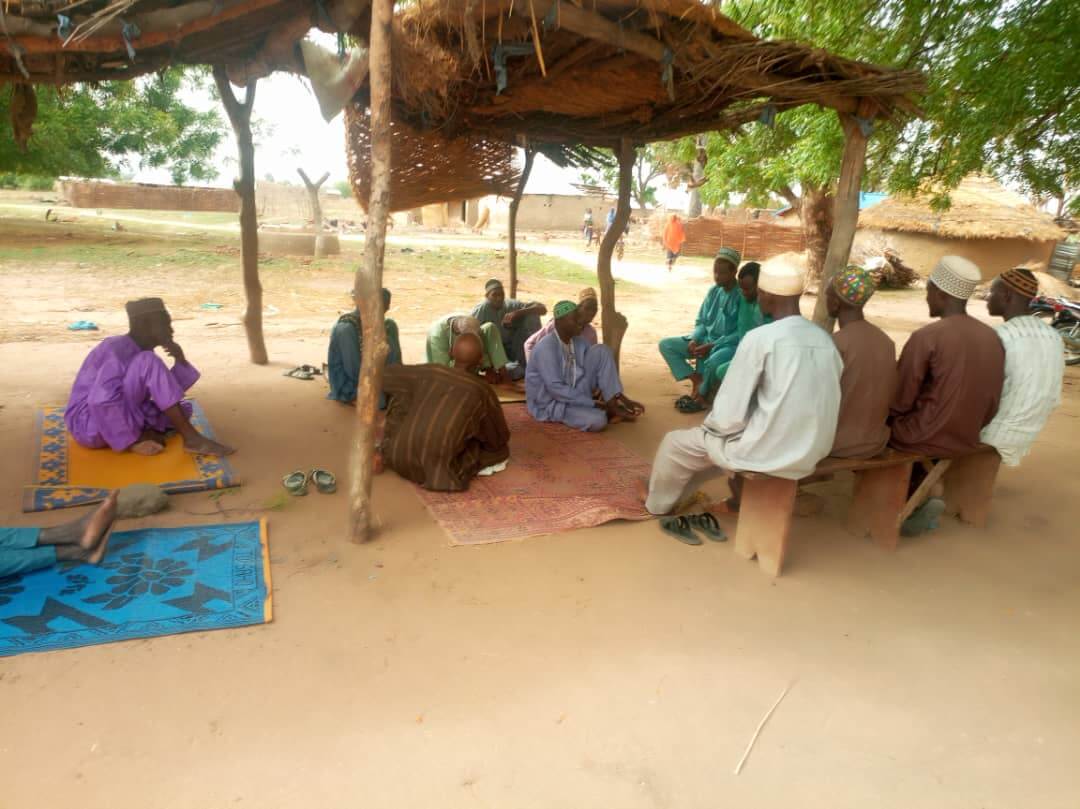
Photo: One of the project’s dialogue meetings with Peuhl herders in the village mentioned in this story, in nothern Benin
While environmental changes play an increasing role in driving conflict, our work with impacted communities gives us hope. We have seen that local communities can and do make a tremendous difference — strengthening their own safety and resilience, bringing their vital knowledge to decision-making processes, and building networks to prevent regional conflicts.
This story from our collaborative Building Climate and Conflict Resilient Communities project in Benin shows how impacted communities can set a powerful example of local agency in the face of larger challenges:
In March of this year, violent clashes unfolded in a village in northern Benin — a participating community in our Building Climate and Conflict Resilient Communities (BCCRC) project. An altercation between a Peuhl (Fulani) herder and a Dendi farmer quickly spiraled into retaliation, displacing an encampment of Peuhl herders. Homes were razed, cattle were killed, and people were severely wounded.
This is an unfortunately frequent conflict scenario throughout the West African Sahel, where weather changes are creating additional stress on communities that depend on agriculture. It has contributed to rising conflict between farmers and semi-nomadic or nomadic herders, often along ethnic lines.
After the violence in that village in March, some community leaders severed ties between farmers and herders, and restricted communication between Dendi and Peuhl people. However, local leaders did approve one form of contact: They allowed their constituents to attend BCCRC’s first training in dialogue facilitation, in April 2024, because of the trust established already with our partner, Association Coexister, a local Beninese peacebuilding organization.
Since that initial training, community ties between Peuhl and Dendi people have continued to strengthen. Participants took the initiative to form peace committees — across ethnic lines, and inclusive of women and youth — at each of the four program sites. These committees now work together to address a variety of conflicts, even domestic disputes, through peaceful means.
Our BCCRC project empowers farmers and herders to better anticipate and respond to tensions like those experienced in Garou — by disseminating essential weather data, and addressing conflict through inclusive, community-driven peacebuilding systems.
These local stories of conflict transformation can mark the difference between safety and danger. When a conflict is resolved nonviolently, the positive impacts ripple out; it means that families do not have to flee their homes to find safety, kids can go to school, crops and livestock are not harmed, and there is improved food security.
Our work in Benin — and our collaboration in the Protecting Our Communities Initiative, over the past five years in Nigeria — reminds us that, through dialogue and cooperation, communities that have been deeply divided can collaborate in the face of monumental challenges.


